

The first year of your baby’s life is an incredible journey of discovery, not just for them, but for you too. From the very first smile to the first signs of independence, every month brings visible and invisible transformations. While physical milestones like crawling and walking often steal the spotlight, your baby’s cognitive and emotional development forms the foundation for learning, relationships, and well-being throughout life.
During these early months, your baby’s brain is building millions of new neural connections every second. Emotional growth also flourishes through loving interactions, your touch, your voice, your presence. Understanding what’s happening month by month helps you respond with sensitivity and confidence, nurturing both your baby’s mind and heart.
Let’s explore how your little one’s cognitive and emotional world blossoms through their first twelve months.
Month 1: The Newborn’s Emotional Awakening
In the first month, your newborn’s world is dominated by sensations and instincts. Though they can’t yet understand or express emotions, their brain is absorbing the feeling of safety and comfort through close contact.
Cognitive development:
- Recognizes familiar sounds, especially your voice.
- Begins to focus on high-contrast patterns and faces.
- Starts to associate feeding and comfort with certain cues.
Emotional development:
- Feels security through warmth, touch, and smell.Begins to calm when held or swaddled, a sign of early emotional regulation.
Parent tip: Respond promptly to cries and make frequent eye contact. This builds trust, the emotional cornerstone of healthy attachment.
Month 2: Building Trust Through Connection
By the second month, your baby begins to show early signs of social engagement, the root of emotional intelligence. Their brain is rapidly wiring connections between recognition, emotion, and response.
Cognitive development:
- Starts tracking objects visually.
- Shows anticipation, may quiet down when you prepare to feed.
- Begins to distinguish between different voices.
Emotional development:
- The first real smiles appear, social smiles of recognition and joy.
- Enjoys gentle talking and singing.
- Expresses discomfort more distinctly (e.g., hunger, fatigue, overstimulation).
Parent tip: Talk, sing, and smile often. Your face and tone teach your baby that communication brings warmth and connection, essential to both emotional bonding and language development.
Month 3: Awareness and Early Joy
At three months, your baby’s emotional expressions become richer and more interactive. Their growing awareness helps them engage in early “conversations”, smiles, coos, and giggles that strengthen cognitive and emotional ties.
Cognitive development:
- Recognizes familiar faces and routines.
- Begins to understand simple cause and effect (e.g., “When I coo, you smile”).
- Pays longer attention to visual and auditory stimuli.
Emotional development:
- Expresses joy, excitement, and distress more clearly.
- Seeks eye contact to connect emotionally.
- Starts to mirror your emotions, a foundation for empathy later on.
Parent tip: Use mirror play or gentle peek-a-boo games. These encourage self-awareness and stimulate social cognition, your baby’s understanding that others have feelings too.
Month 4: Curiosity and Emotional Response
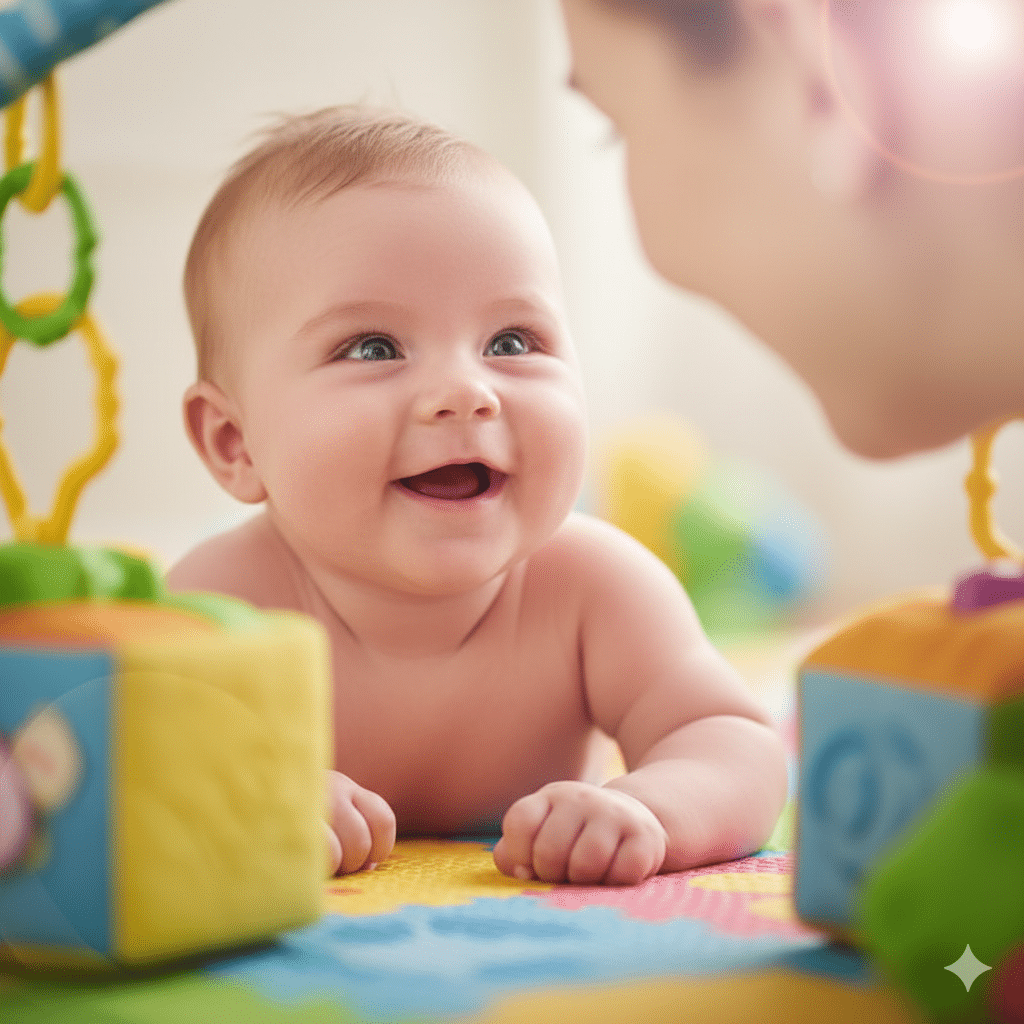
At around four months, your baby’s awareness of the world deepens. They begin to anticipate patterns and show excitement for familiar faces and activities. Emotionally, they’re becoming expressive and responsive, laughter, smiles, and squeals are signs that emotional understanding is blooming.
At around four months, your baby’s awareness of the world deepens. They begin to anticipate patterns and show excitement for familiar faces and activities. Emotionally, they’re becoming expressive and responsive, laughter, smiles, and squeals are signs that emotional understanding is blooming.
Cognitive development:
- Recognizes cause and effect (“When I move, the toy jingles”).
- Follows moving objects across the room.
- Begins to expect daily routines, sleep, feeding, play.
Emotional development:
- Laughs aloud and shows genuine delight.
- Enjoys familiar people and may begin to show slight unease with strangers.
- Starts to differentiate tones of voice, sensing approval or disapproval.
Parent tip: Respond enthusiastically to your baby’s attempts to communicate. Your reactions strengthen emotional confidence and reinforce early learning pathways linked to social interaction.
Month 5: Recognition and Emotional Memory
By five months, your baby’s brain forms stronger connections between memory and emotion. They start recognizing not just faces but also emotional patterns, they know who comforts, who plays, and what feels safe.
Cognitive development:
- Recognizes their name and familiar voices.
- Begins to explore objects with intention, shaking, banging, or mouthing them.
- Shows early problem-solving curiosity.
Emotional development:
- Develops clear preferences for caregivers.
- Expresses joy when seeing familiar people.
- Begins to sense emotional tone in songs and speech.
Parent tip: Narrate your activities in a calm, reassuring tone. Consistent, gentle speech helps shape your baby’s emotional vocabulary and supports language comprehension.
Month 6: Social Play and Emotional Bonding
Halfway through the first year, your baby becomes a social explorer. They’re attuned to facial expressions and may even imitate them. Emotional bonding now drives learning, love and curiosity work hand in hand.
Cognitive development:
- Understands simple action–reaction sequences (“If I drop the toy, it falls”).
- Begins to remember familiar games and routines.
- Experiments with cause and consequence more intentionally.
Emotional development:
- Smiles or laughs in response to others’ emotions.
- Shows early empathy, may react when another baby cries.
- Begins to show separation anxiety, a sign of healthy attachment.
Parent tip: Engage in face-to-face play, peek-a-boo, mirror time, and gentle laughter games. These strengthen neural circuits that connect social learning with emotional regulation.
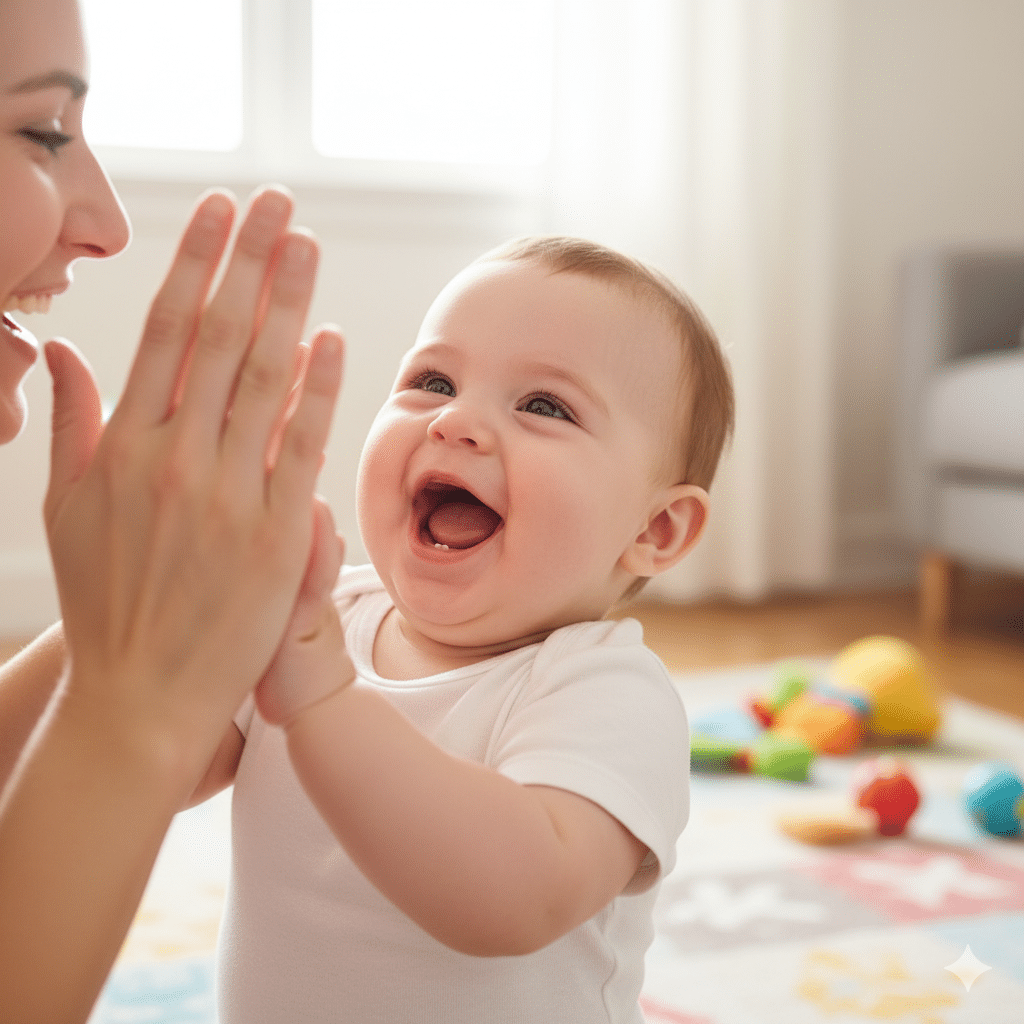
Interactive games like peek-a-boo teach your baby emotional cues, empathy, and social joy.
Month 7: Exploration and Recognition
By the seventh month, your baby’s curiosity expands beyond what’s familiar. Their developing memory helps them recognize people, voices, and places, which strengthens their sense of security and belonging.
Cognitive development:
- Understands the concept of object permanence, realizing that things and people still exist even when out of sight.
- Begins to imitate simple sounds and gestures.
- Enjoys cause-and-effect play, like pushing buttons or dropping toys.
Emotional development:
- Expresses joy and excitement with laughter or clapping.
- May show anxiety around strangers or when you leave the room a healthy sign of attachment.
- Starts to form emotional bonds beyond primary caregivers.
Parent tip: Play simple hiding games like “Where’s the toy?” This strengthens both memory and emotional reassurance, showing your baby that people and objects return even after disappearing.
Month 8: Independence and Emotional Expression
At eight months, babies begin to balance attachment and exploration. They’re eager to move, discover, and interact while still relying on your emotional presence as a secure base.
Cognitive development:
- Experiments with actions to see your reactions, early signs of social reasoning.
- Understands familiar routines and may anticipate what comes next.
- Begins to associate specific words with actions (“bye-bye,” “bottle,” “no”).
Emotional development:
- Displays a wider range of emotions: pride, frustration, curiosity.
- Seeks comfort from caregivers when upset.
- Starts showing affection by reaching for you or snuggling.
Parent tip: Encourage exploration in safe environments. When your baby ventures away but looks back for reassurance, respond with a smile, this builds secure attachment and emotional confidence.
Month 9: Problem-Solving and Early Empathy
At nine months, your baby’s cognitive and emotional worlds intertwine in powerful ways. They begin to solve simple problems and sense emotional cues in others.
Cognitive development:
- Engages in early problem-solving, may try different ways to reach a toy.
- Recognizes familiar words and gestures.
- Begins to use purposeful sounds or babbling to communicate needs.
Emotional development:
- Understands emotional tone, may react if you look sad or pleased.
- Begins showing early empathy when others are upset.
- Seeks praise and encouragement for new accomplishments.
Parent tip: Describe emotions during play or daily routines (“You’re happy,” “That scared you”). Labeling emotions helps develop your baby’s emotional intelligence and lays groundwork for language–emotion integration.
Month 10: Understanding and Imitation
By ten months, your baby is watching everything you do and learning through imitation. This stage marks a powerful leap in both thinking and feeling, as your baby starts connecting actions, emotions, and words.
Cognitive development:
- Understands simple commands like “come here” or “no.”
- Begins to use objects correctly (brushing hair, holding a spoon).
- Practices problem-solving by experimenting with objects.
Emotional development:
- Shows pride after completing small tasks.
- Becomes more expressive, laughter, surprise, and even protest.
- May comfort themselves with a favorite toy or blanket.
Parent tip: Model gentle behavior. When you express emotions calmly, your baby learns how to regulate emotions by observing and mirroring you.
Month 11: Memory, Bonds, and Social Awareness
At eleven months, your baby’s emotional world becomes richer and more intentional. They now remember familiar people, routines, and even reactions, shaping early social understanding.
Cognitive development:
- Retains information and recognizes familiar places.
- Begins to use gestures to express meaning (pointing, waving).
- Experiments with solving new challenges — stacking, opening boxes.
Emotional development:
- Distinguishes between familiar and unfamiliar people.
- Displays affection freely, hugging, smiling, offering toys.
- May show frustration when limits are set, a normal step toward autonomy.
Parent tip: Provide predictable routines and consistent responses. This helps your baby feel safe, encouraging both emotional stability and trust in relationships.
Month 12: First Words and Emotional Understanding
Your baby’s first birthday marks the beginning of a new chapter. The brain now integrates emotions, memory, and communication in remarkable ways, forming the basis of early personality.
Cognitive development:
- Understands simple instructions and begins saying first words.
- Uses gestures intentionally to express needs.
- Remembers familiar routines and outcomes.
Emotional development:
- Expresses a full range of emotions, joy, fear, curiosity, affection.
- Seeks approval and reassurance.
- Begins to show self-awareness, recognizing themselves in a mirror.
Parent tip: Celebrate small achievements and respond warmly to first words or steps. This positive feedback reinforces your baby’s confidence and strengthens the bond between emotion, learning, and motivation.

Frequently Asked Questions About Cognitive and Emotional Development in the First Year
What’s the difference between cognitive and emotional milestones in the first year?
Cognitive milestones involve how babies think and learn—attention, memory, problem-solving, and early language. Emotional milestones involve how babies feel and connect—bonding, soothing with a caregiver, social smiles, and expressing joy, frustration, or fear. Both develop together through daily, responsive interactions.
How can I support my baby’s cognitive and emotional growth month by month?
Respond promptly to cues, make frequent eye contact, narrate routines, sing and read daily, and offer short, frequent tummy-time and play. Celebrate small attempts (coos, smiles, reaching) and keep a calm, predictable rhythm for feeding, sleep, and play to build trust and curiosity.
When should I talk to a pediatrician about development?
Every baby develops at their own pace, but check in if by 9–12 months your baby rarely responds to sounds, avoids eye contact, shows very limited facial expression, doesn’t babble or gesture (like pointing/waving), or seems uninterested in people. Early guidance can be reassuring and helpful.
How do routines help brain and emotional development?
Predictable routines lower stress and help babies feel safe. When feeding, sleep, and play have a gentle rhythm, babies can focus on exploring, remembering patterns, and connecting with caregivers—the building blocks of later learning and self-regulation.
What are simple ways to build early empathy and social understanding?
Mirror your baby’s expressions, label feelings (“You’re excited!”), play face-to-face games (peek-a-boo, mirror play), and use a warm tone. Comfort quickly during distress; consistent soothing teaches that emotions are manageable and relationships are safe.
My baby shows separation anxiety—is that normal? What should I do?
Yes—from around 6–12 months, it’s a healthy sign of attachment. Use brief, consistent goodbyes, return when you say you will, and offer a reassuring tone or comfort object. Practice short separations to build confidence over time.
Do premature (preterm) babies follow the same milestone timeline?
Often you’ll track milestones using “corrected age” (subtract weeks born early from actual age). Partner with your pediatrician to interpret milestones using this adjusted timeline.
Does screen time help or hinder first-year development?
Live, responsive interaction fuels brain and emotional growth best in the first year. If screens are used, keep them minimal and co-view while talking about what you’re seeing. Prioritize face-to-face play, singing, reading, and everyday connection.
The First Year of Minds and Hearts
Your baby’s first year is much more than physical growth, it’s a journey of emotional connection and cognitive awakening. Every smile, babble, and gaze shapes how your child will later think, learn, and love.
By tuning into your baby’s cues, maintaining eye contact, talking, and responding with warmth, you’re doing far more than nurturing, you’re building the architecture of the brain and fostering a sense of security that lasts a lifetime.
Each moment, no matter how small, contributes to a foundation of trust, curiosity, and resilience the essential pillars of lifelong emotional health.